
By: Katrina Yasmien Atienza, Hershey Juan, Daniella Monreal

Menve Rodrigueza doing the first step of making an abaniko called “pagbahan” at their home in Bascaran, Daraga, Albay.
Abaniko weaving as a generational livelihood
In the municipality of Daraga, Barangay Bascaran is well-known for its many abaniko (hand fan) weavers. Most of the families residing here have been making abaniko pamaypay for years now and it has been passed down from generation to generation. Many of them have been able to send their children to school through abaniko-making and according to them, without abaniko, Bascaran residents would struggle.
Menve Rodriguenza, a 35 year-old abaniko weaver grew up watching her parents make and sell abaniko for a living. Ever since she was a child, she already witnessed the process in which these fans are created.
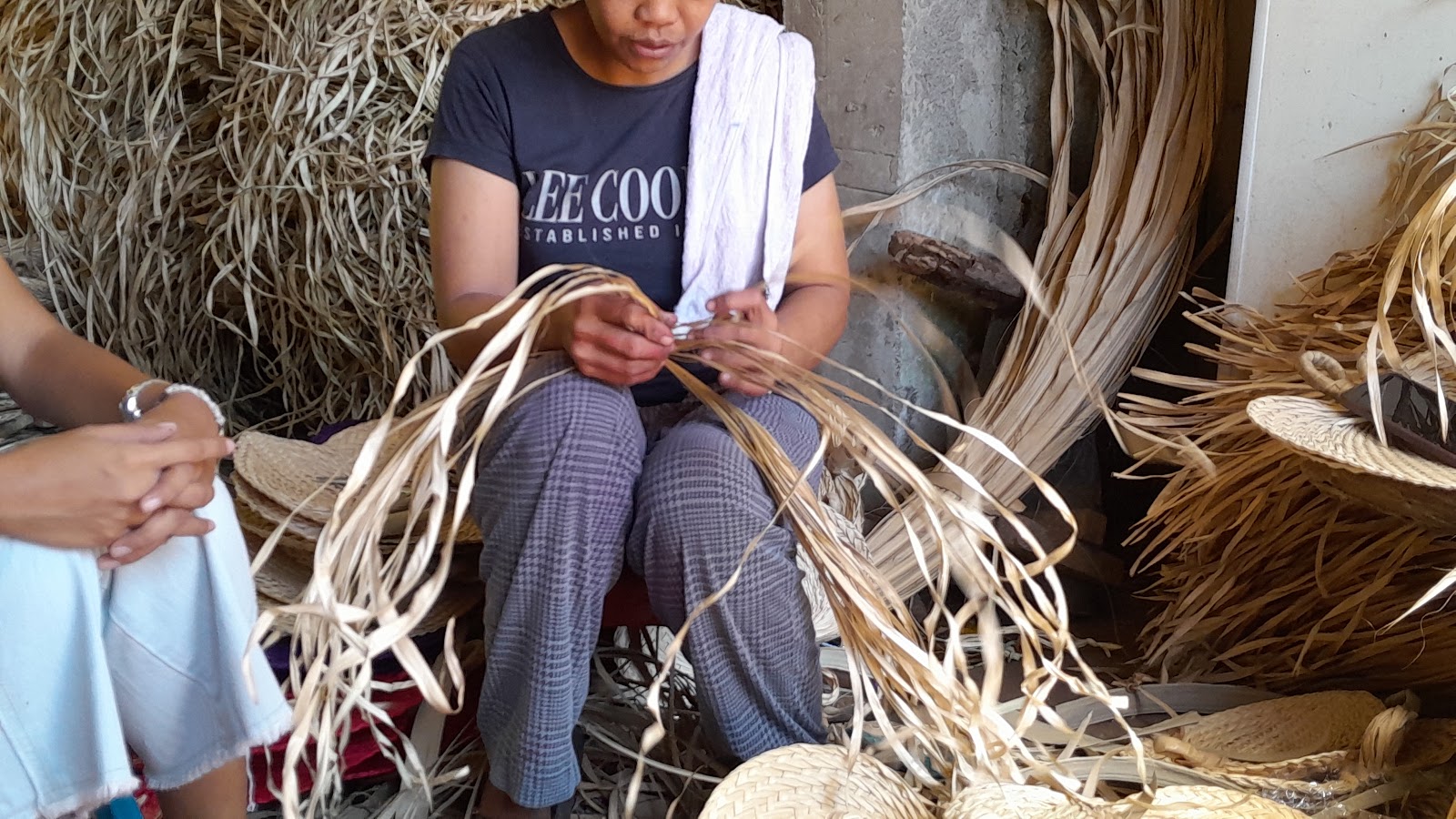
Menve Rodrigueza doing the “pagbahan” step of making an abaniko at their home in Bascaran, Daraga, Albay.
Her mother is the one who taught them to make abaniko. “My mom used to sell these but it actually started when we were still kids, when we were still in elementary school,” she said. For their family, these fans are not just a simple product of labor, but one of the critical foundations that keeps their family going.
Rodrigueza delivers and has the abaniko picked up three times a week, and each pickup costs around ₱6,000 for 300 pieces depending on the size of it. “Clients order different sizes of fans, so our earnings depend on their orders. They usually pick up their orders on Mondays and we get paid P 6,000 for it.” she said.
“It is good when it is summer. But when it rains, it gets difficult because we cannot dry the leaves and they get rotten.” Rodrigueza added.
The climate in the Philippines has been a challenge to handle, especially the sudden shifts of temperature. One of its major effects is the continuous warming of the planet. Just recently, Legazpi recorded a 43℃ heat index, which is already at the danger level according to the Philippine Atmospheric, Geophysical and Astronomical Services Administration (PAGASA).
Furthermore, climate change also affects the intensity and frequency of precipitation. As per United States Environmental Agency, Warmer oceans increase the amount of water that evaporates into the air. When more moisture-laden air moves over land or converges into a storm system, it can produce more intense precipitation—for example, heavier rain and snow storms.
These environmental changes cause different impacts to people. For Bicolanos, one of the biggest producers of the handicraft “abaniko” in Luzon, these changes are threats to their livelihood.
Since the sunlight is a critical part in the pamaypay making process, the rain is bad news for abaniko makers.
It doesn’t just hinder the drying of the materials, it also lessens the buyers. The rainy season means cold weather and who needs a fan when the weather is already cold? According to abaniko weavers from Bascaran, Albay, the rainy season is their enemy.
Aside from this, harvesting anahaw leaves during time is also difficult. The muddy and slippery path to the location of the plants gives the anahaw makers an extra struggle. After going through all these troubles, they will only earn 50 centavos per leaf.
For other crafters like Evelyn Marinay, a 78 year-old abaniko manufacturer and dealer, these fans paved the way for their success.


Evelyn Marinay’s daughter-in-law and some of their helpers preparing colored fans before it gets picked up.
She and her husband started their abaniko business when they just got married. They started by selling the fans by themselves and then as time went by, people started ordering from them. Since then, they hire people to make the fans for them while they provide them with the needed materials. They were able to send all of their children to school because of this business. It became their source of income up until this day.
Marinay started her abaniko journey with her husband, but since his passing, the business has been handled by their children. Their income was never not enough for them since the founding of their business. This just describes how big the demand for traditional fans is. Through dealing with clients, Marinay wasn’t just able to provide for her family. She is also helping other households thrive by hiring them to make the craft
Crafting the work’s origin
Abaniko is also called pamaypay in Tagalog. Its name originated from the Spanish word abanico meaning “fan”. This handicraft was mostly used by women as a fashion item in the early 20th century. During this time, there is this thing called “fan language” which is used by young ladies to discreetly send messages to their potential suitors. It was said that if a lady flutters her fan over her face, she is acting flirty. On the other hand, if she closes her fan, she is not interested. This social practice is closely related to the Spanish culture which it originated from.
More than just a tool for providing air, abaniko is a symbol of Filipino identity, craftsmanship, and resilience for the people who are experts in making this native craft. It is a traditional handcrafted fan made from anahaw, the national leaf of the country that yields a unique viewpoint to explore environmental sustainability.
There are two types of plant that can be made as a woven fan, the buhi palm leaf and the traditional anahaw leaf. In barangay Bascaran, anahaw leaves are what they prefer. The process of making this traditional woven fan costs an unbelievable amount of time and energy. The finished product may seem simple but it goes to a number of processes before its final form materializes. Rodrigueza highlighted the process of crafting that uses the most eco-friendly materials and procedures.
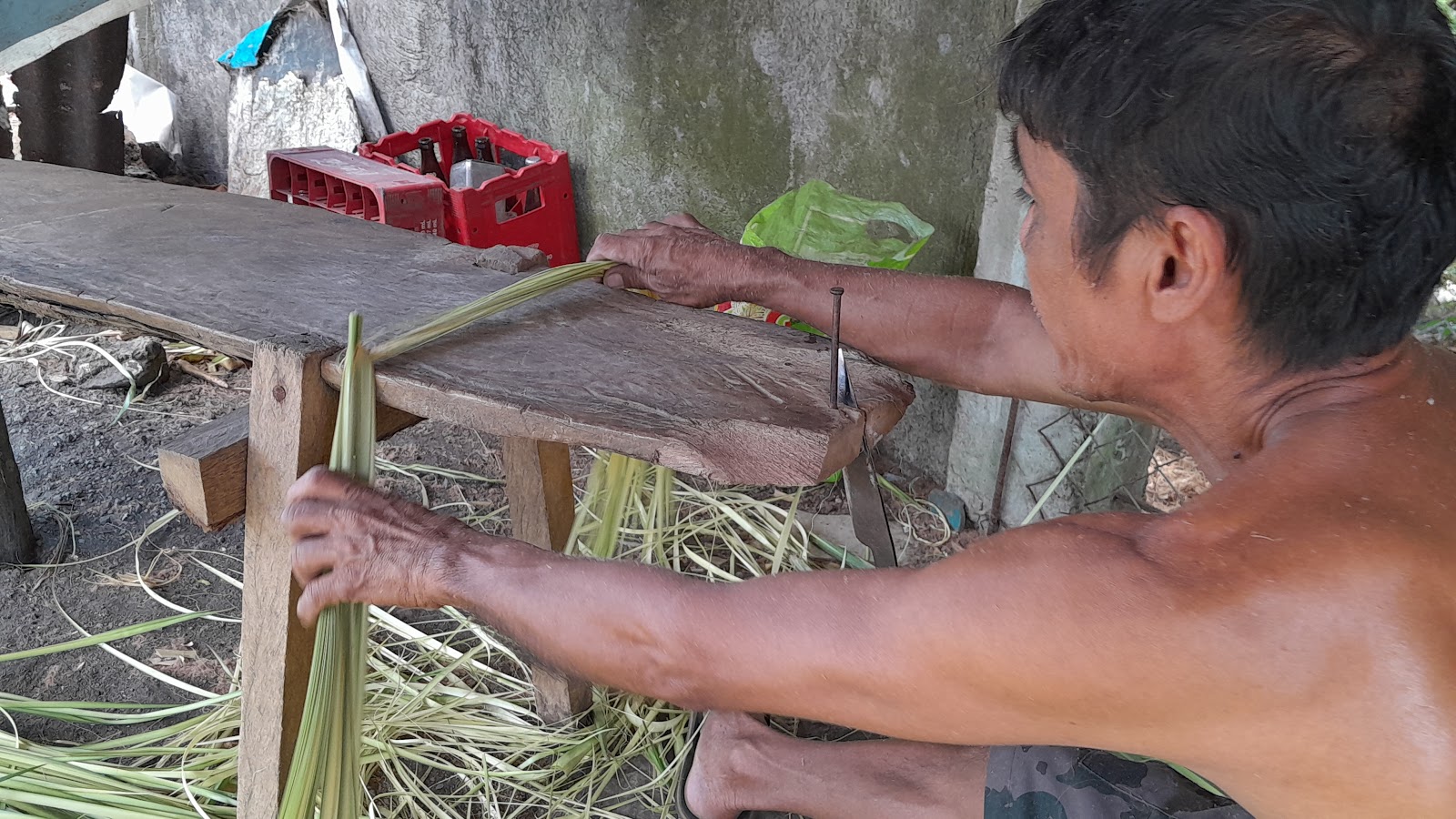
One of Rodriguez’s helpers demonstrated how to separate the anahaw leaves into strips (pagriras).
First, they harvest the anahaw. They only use the premature leaves that are not yet opened. Next, they separate the leaves into strips through a process called “pagriras.” Men are mostly tasked to do this step since it requires strength and endurance. And then, they wait for the strips to lighten by drying them under the sun.
After drying, they begin assembling the sun-dried anahaw through a method known as “pagbahan.” The most difficult part follows, locking the abaniko by tightening the anahaw strips during the process called “pagsapoy.” According to Rodrigueza, this part often causes backaches because it requires a lot of strength and time to complete. Lastly, they cover the handle through the process of “pagbudbod,” which involves wrapping another thick strip of dried anahaw into the end of the leaf.
Abanikos are not just used to relieve the heat. It also serves other purposes such as souvenirs, giveaways, props, and design for different events like festivals.
Abaniko vs. portable electric mini fans
At the start of the summer season, people are fighting against the extreme heat caused by the heat index. The human body can only handle so much heat that one of its cooling mechanisms is through sweating. Mini portable electric fans are the latest trend these days. They are not just convenient because of the scorching heat, it also serves a cute fashion item for some people. Most of these fans are rechargeable or battery powered. It is not surprising that almost everyone owns one of these gadgets these days, given the high heat index in the country.
Despite the emergence of these mini fans, the abaniko industry is not affected. As per Rodrigueza, even though these items are already trending, the amount of demand for the traditional fans is still the same. She believes that it is because these miniature fans are useless once they run out of battery. This is also why a lot of people still prefer to use the traditional abaniko. Aside from the fact that most of these electronic fans are expensive, they also contribute to the world’s overall electricity consumption.
Johnvic Grageda, an engineer and officer-in-charge of Municipal Environment and Natural Resources, says that the creation of mini fans contributes to the degradation of the environment. Aside from this, electronic fans are more pricey. Compared to the abaniko which uses raw materials for production, these items are less cost efficient. If these two are weighed out, it is easy to point which is more sustainable to use.
Portable mini fans are just one of the many technological advancements that will happen globally. Considering the current state of the climate and the continuous growth in modernization, it is not impossible that new technologies will be made in the future to combat the heat. The world is continually evolving and humans are constantly improving. Despite the changes that are happening, traditional industries are still thriving. Just like the abaniko industry in Bascaran, Albay. Decades have already passed but the tradition and craft is still existing. As long as there are people who are making these artworks, it will also continue to prosper through time.
Abaniko weavers in Bascaran, Daraga, Albay showcasing the various steps in creating the craft.
 Bicol Daily News
Leave a comment