by Alexandra Hera Lumibao, Hero Nocillado, and Jhoana Orense
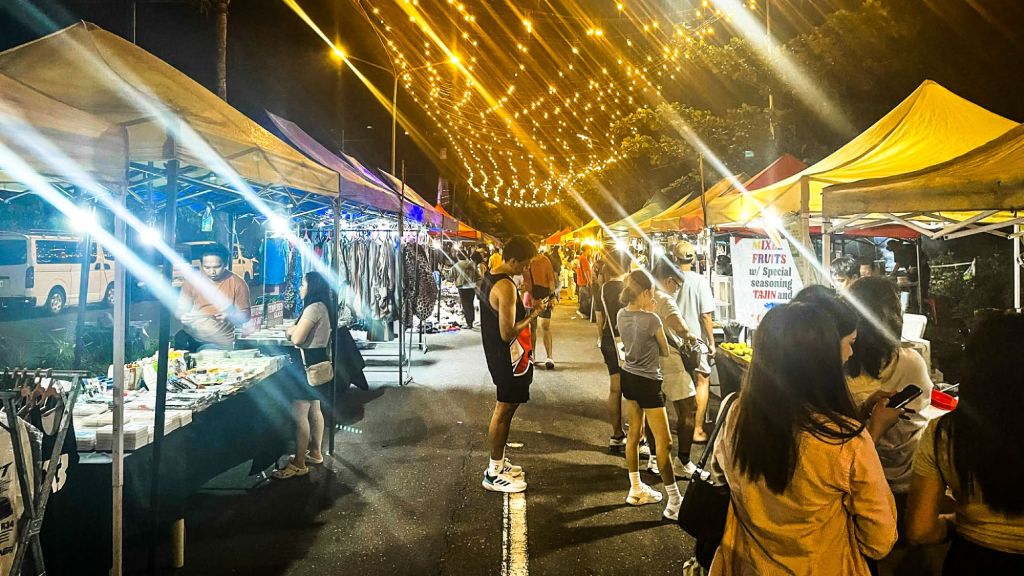
Legazpi City, Albay — The Legazpi Night Market is no longer just about surplus clothes and grilled food. Small, creative businesses are now making the place stand out with fresh and unusual ideas.
One such entrepreneur is Thirdy Rio Perez, who has secured a prime spot near the entrance to offer tarot readings and lucky charms.
Perez has only been operating for five days, after moving from Sawangan Park, but he already earns between ₱3,000 and ₱4,000 on busy weekends, and around ₱500 to ₱1,000 on slower days.
He said the new location brings in more customers compared to Sawangan, adding that the street has recently developed into a tourist destination with steady foot traffic. “I’ve already had foreign customers—around nine of them, including French, American, Chinese, Korean, and Thai,” he said.
The night market has been a game-changer for Perez, providing a supportive environment that has helped his unusual business the chance to grow.
Nearby, Sharon Bien’s piercing and jewelry stall continues the shift toward more niche offerings.
She has been in the business for three years and continues to keep her prices relatively affordable. “We need to prioritize budget‑friendly prices because most of my clients are students. That’s why the price range is only from ₱350 to ₱1,000—student‑friendly and something they can afford,” she explained.
For Bien, the Legazpi Night Market has served as an effective platform for her seasonal business. “I was planning to have a shop, but this kind of business isn’t really in demand, especially here,” she explained.
The market lets her reach more people without the costs of running a permanent store.
Conceptualizing the night market
The Legazpi Night Market as it exists today was far from this level of organization. Before settling into its current location, the area was never intended to serve as a commercial space.
According to engineer Jennybeth Agripa, one of the minds behind the project, the space originally had a very different purpose.
“The space was once intended as a jogger’s lane,” Agripa explained. “But vendors began utilizing it as a selling area, often occupying mountain road shoulders, which created safety and traffic issues,” she said.
In an effort to improve public safety while also protecting vendors’ livelihoods, Legazpi Mayor Hisham Ismail decided to formally establish the night market.
“People may be considered violators because we have a DILG memorandum that prohibits selling in those areas, and by doing so, they become obstructions. The mayor addressed this with a proper, win‑win solution—clearing the roads and joggers’ lane while providing an appropriate selling area for small and medium business enterprises,” Agripa said.
A growing marketplace
Looking back, Agripa compared the market’s early days to its present scale. “When we first organized this, I don’t think we even reached 20 vendors,” she said.
Today, the night market has 186 stalls, including 98 food vendors and 88 non‑food vendors. It has become a place where different kinds of businesses can thrive, showing that the local economy is growing beyond just food stalls.
“The market significantly widens opportunities for vendors of non‑food items to sell and offer their products,” Agripa said. “This caters to diverse interests, especially now that large numbers of people are visiting the area,” she added.
This variety can be seen even at the far end of the market, where the Bicol Dog Community has built a niche in pet fashion. Co-owned by Krisha Monis, the business started in 2018 as a hobby inspired by her dog’s love for fashion shows.
“He loved wearing clothes and joining fashion shows and pet shows, so we would always let him participate,” Monis said. “That’s why we eventually decided to turn it into something we do more seriously,” she added.
What started as a pastime eventually grew into a livelihood, as Monis began importing outfits from Korea. The business now offers casual wear priced between ₱50 and ₱200, along with more expensive pieces for dog shows.
The night market provided the visibility the business needed. “It helps because before, people didn’t know that this kind of product existed. Now, they prefer to come here,” she said.
Monis noted that the business had seen a good run since its October launch.
This success is exactly what local leaders hoped for. Beyond being a place to eat and shop, the Legazpi Night Market has become a tourist attraction. In an interview with Brigada News Legazpi, Alan Rañola, city councilor and chair of the Committee on Trade and Commerce, emphasized that the market’s revival goes beyond the introduction of a new attraction. He explained that it also provides valuable opportunities for local entrepreneurs and artists to showcase their products and creativity.
Since opening in September at Puro, Legazpi, along the Mega Tourism Highway, the night market has grown into more than a dining spot. Near the Obelisk, it now serves as a launchpad for unique ventures that thrive alongside traditional grills, proving that even small, unconventional businesses can succeed in this lively hub of livelihood and tourism.
 Bicol Daily News
Leave a comment