By Shyr Biton, Mary Joy Buelva, & Charmaine Casais

FLOW. The Yawa River flows through the heart of Barangay Malobago, Daraga, acting as both a vital water source and a major transportation barrier for local farmers. (Photo Courtesy: John Robert Bitancor)
ALBAY, Philippines – A narrow, unstable footbridge sways above a restless river in Barangay Malobago. Built as a temporary solution, it has become a recurring reminder of uncertainty—washed away by floods, rebuilt, then lost again. For residents, vendors, and even children, crossing this river is no longer a simple task but a daily gamble, one that tests their courage, endurance, and will to survive.
For local vegetable vendors, the bridge is more than a pathway—it is a lifeline.
Jenny Kris Padilla, 34, travels daily to the night market carrying freshly harvested vegetables. She often crosses the river barefoot when the fragile bridge is washed out.
”We have no choice; we will definitely pass through Kilicao because there is a bridge that allows us to exit there,” she said, referring to the alternate route that adds travel time but provides a safer crossing. Even then, transporting there produces more taxing.
By transporting her products to the market and selling them, she still wants to walk through that bridge in Malobago even if it is not that strong enough since it is the most convenient and it takes less time to travel.
Padilla hopes for a permanent concrete bridge—one that would allow residents to cross the river safely and transport their goods without damage.
“Hopefully, if we could or provide us a bridge, even a small one, so that we don’t have to cross the river anymore, something stronger that will make it easier for us to get to the market, so that our goods are safe, because if we go around there, our vegetables will rot,” Padilla said, hoping for that bridge. A bridge that is a non-living but a living trial for her as a vendor and as a resident of the barangay.
For Padilla, the bridge is more than a structure. It is a daily trial—silent, unmoving, yet deeply intertwined with her survival.
She is the sole provider for her six children, caring for them alone while her husband suffers from a stroke. Each morning, she harvests eggplants, garlic, onions, and water spinach. By 5 p.m., she heads to the market, hoping her vegetables—and her strength—will last the journey.
”If we stop selling, we will go hungry because I am the sole provider for my children. So, we really have to scrape together every day just to survive,” she shared. Her eldest child, only 14, helps her carry goods, balancing work with school.
Meanwhile, Maricel Seña, 48, also recalls the hardships of traversing the river to bring her vegetables to the market.
”It’s really hard, but there’s just nothing we can do. Our only source of livelihood, of course, is selling vegetables,” she said, describing how strong rains force vendors to stockpile or even give away produce to avoid spoilage.
Both vendors agree: the lack of a permanent bridge affects not only their livelihood but also the entire barangay’s access to markets, education, and essential services.
”I hope they bring back the old bridge because the current situation is really hard. When you go to the market, you have to walk across [the river], and it’s difficult, especially when you are carrying heavy goods. That’s why we had a cart built for that purpose,” Maricel added, emphasizing the human cost behind each crossing.
The fragile makeshift
The crossing at Malobago isn’t a bridge, just a temporary solution. It is made of two steel poles and a wooden plank held up by large rocks on the riverbank. The structure is weak, and when the Yawa River swells, nature can easily swallow it whole. This fragile footbridge is the only thing keeping residents from drowning or being swept away by the current.
When the rain is heavy, the river can expand to an estimated 100 to 200 meters. The banks turn muddy and slippery, and debris, including scattered rocks from nearby Mt. Mayon washes down, adding another serious safety risk to everyone who crosses. Because it is so prone to washing out, the Barangay Captain must fix this footbridge repeatedly, sometimes three times a week, just to keep life moving.
For Barangay Captain William Marbella, this struggle is nothing new. He grew up crossing the river this way, just like his parents and grandparents.
”I’m used to it, because I grew up there. My grandfather, my father, my mother, we’re all used to it, that every time it floods we don’t really have good [transportation] access,” he shared.
In addition, he stated that the challenges from the previous administration persist even in his second term. He also revealed that the city government, together with Congressman Caloy Loria, has already outlined a proposed bridge project and is pending approval.
Yet, on the ground, progress is slow. In Barangay Kilicao, repairs have only just resumed. A steel bridge that connects Binitayan and Kilicao has been under construction since 2007 and remains unfinished as of 2025.
”The Kilicao project, even now, is still not finished. Several barangays benefit from it. I have a subsequent project there [in Malobago], which has also been approved by Congressman Kaloy; it will probably be included when the [General Appropriations Act] GAA is released,” the barangay captain revealed.
He admits that he is compelled to rebuild the bridge using his own personal funds because there is no official budget for it. He must wait for the river to calm down before he can even lay the planks, hoping the water won’t destroy it before it can be used. In Malobago, the repeated need to rebuild the footbridge has turned into a routine of life, revealing how the residents are left to depend on short-term remedies rather than sustainable infrastructure.
Marbella has tried to pave an alternate, safer route, but for most residents, the shortcut across the river is the only practical option. The safer way, through Barangay Kilicao, takes too much time and adds distance, a cost that vegetable vendors and farmers simply cannot afford in their daily work.
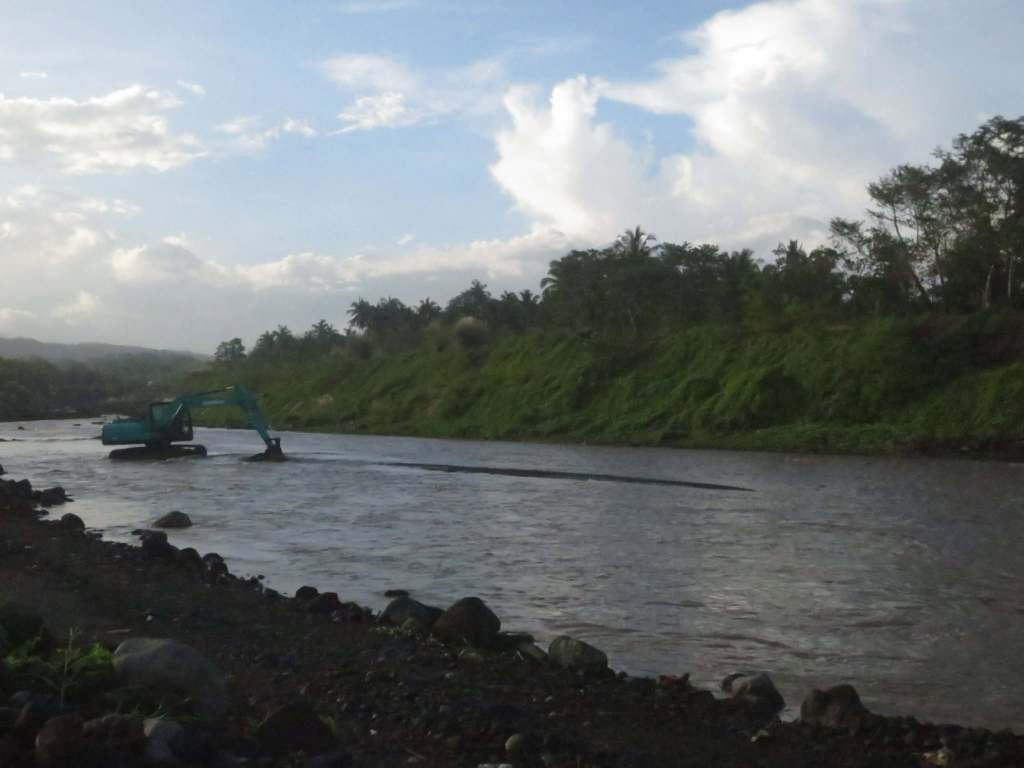
THE GAP. A section of the river remains without a permanent bridge, leaving a critical gap in the community’s access to essential urban services. / via Mary Joy Buelva
Patience vs risks
In a statement given by Daraga Municipal Mayor Victor Perete, he believes that residents are successfully using the detour route by the Kilicao bridge as a means of transportation.
“Since the detour bridge is operational, vendors still continue to use it and it does not disrupt their daily livelihood source,” Perete shared.
However, the Mayor’s statements contradict the struggles reported by residents, which points to a disparity in understanding between the administration and the community. Mayor Perete insists that construction is “Ongoing” without providing a detailed timeline for the project. “None that the [Local Government Unit] LGU is aware of,” the only detail he could offer when asked why the project was stalled.
The Mayor insists that the administration is doing its best and asks the public for support and patience.
“Be patient since the LGU is doing its best to serve the interest of everyone. We expect their utmost support, understanding, and cooperation to ensure completion of the project with the highest standard possible to ensure safety and sustainability,” the Mayor shared.
This call for “patience” comes while the community continues to rely on a man-made footbridge, struggling with the reality of a political process that remains stalled.
The only crossing
The difficulties were also faced by 12 year old kids, Kian Bon and Jamal Llorca. They cross the river several times a week, sometimes for school, always adjusting to what the current decides for the day. When the water is calm, they are lucky enough to cross safely through the man-made footbridge. When the water rises, they waddle through waist level currents of water.
And at times, they walk through the river to sell some vegetables—not to the market but also to the adjacent barangay. Despite the obvious safety risks and the inconvenience of crossing, the two children see it as a necessity. It is the only way they can transport freshly harvested vegetables to a neighboring barangay to earn extra income.
Selling vegetables has become one of the few ways they can provide for their school needs without relying heavily on their parents.
“We want to have a bridge here in Malobago, we want to walk here because it is closer than travelling in Kilicao,” Kian said as they hoped for a bridge, to ease the struggle in crossing the river and help them to be at ease.
A single, fragile, man-made footbridge stands between them and their livelihood. Over time, both have grown accustomed to the river, learning to play in its flow and even swim—an essential skill when the water rises beyond a safe depth.
Living under layers of bureaucracy, the prospect of a permanent bridge project feels like a distant hope.
”The bridge was washed away again because of the constant flooding. [We were told] it wasn’t fixed yet because there was a lot of other work [that needed to be done],” Llorca stated.
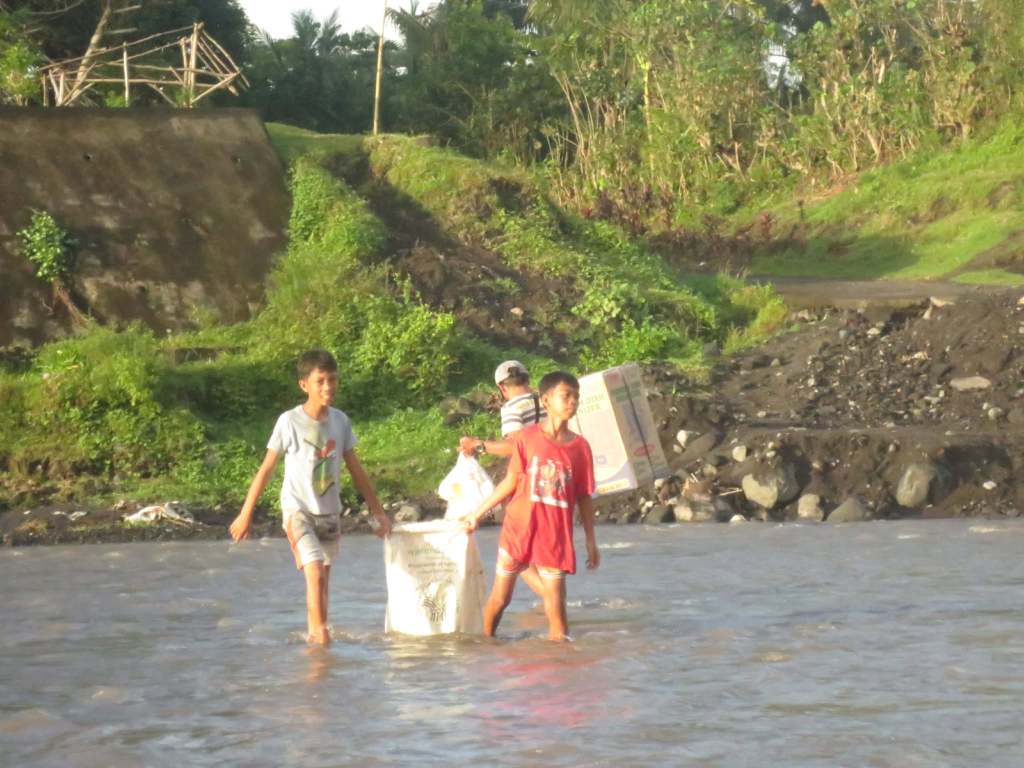
YOUNG VENDORS. Twelve- year- old kids, Kian Bon and Jamal Llorca, wade through the river to sell vegetables in neighboring barangays. / via Mary Joy Buelva
Barangay Malobago is a community defined by its fertile land and the unwavering cooperation of its residents. Nestled at the foothills of Mayon Volcano, its rich soil provides a vital livelihood through agriculture, yet the absence of a permanent bridge remains the single greatest barrier to its growth.
While the community maintains its quiet, rural identity, the residents of Malobago are no longer asking for temporary remedies or calls for patience—they are asking for the infrastructure they deserve.
A permanent bridge would do more than just span a river; it would secure the safety of children like Kian and Jamal, protect the harvests of vendors like Jenny Kris and Maricel, and finally connect this hardworking barangay to the essential services and economic opportunities of Daraga. The survival of Malobago’s livelihood depends on a lasting solution; it is time to build a bridge that finally matches the strength of its people.
 Bicol Daily News
Leave a comment